So, after watching the Oscars I can say I'm moderately impressed. For the most part, the most common errors I saw were the massive number of four-in-hand ties replacing bow ties, which I'm somewhat willing to forgive despite my better judgement, and lack of waist covering. However, there were some notable goofs as well as some well dressed gents at the event (unfortunately, I'm no judge of women's evening wear so we'll be sticking to the fellas).
First off, when I caught a glimpse of Billy Crystal in white tie, I was excited...for a brief period until I saw his waistcoat laying FAR below the front of the tailcoat and the use of a soft, turndown collared shirt. Poor form for Billy or whoever it is who planned his wardrobe. It's worth noting that Robert Downey Jr. made the same goof at the Golden Globes this year. Once Billy changed to Black Tie, however, he was looking pretty good, even if the vest was a bit high gorge for my taste.
Christian Bale once again showed up in his all black ensemble, destroying all of the elegance associated with black tie. Martin Scorsese and Jonah Hill did the same, but at least they wore bow ties (not that it excuses them at all, mind you).
Cheers to Christopher Plummer for donning a midnight blue, velvet jacket with black piping. It was a daring risk and it paid off in spades for him.
Extra points to Jean Dujardin of The Artist for managing to pull of the "1920s movie star" look both on and off the set.
Zachary Quinto made a daring choice with his black jacket with midnight blue lapels. Not my style, but, in my most humble opinion, it works for him.
As for Robert Downey Jr., while I love him as an actor, the man simply seems to have an aversion to correct evening attire. I almost hesitate to put him here at all as what he wore was more of a suit than black tie. He wore a grey suit, black shirt, and seemingly-bedazzled silver bow tie.
I'll refrain from commenting on Sacha Baron Cohen
I'm not sure what was going on with Stephen Spielberg's collar. Looks like he tried to fold down the tips of a turndown collar to look like a wing collar. Not flattering at all.
Wim Wenders in bright blue bow tie and weird, regency-esque tailcoat...no comment.
James Earl Jones, as always, looked quite the classy gentleman in low cut vest, wing collar, and shawl lapel jacket.
I'm willing to forgive Zach Galifianakis and Will Ferrel for their all-white tail suits during the ceremony seeing as their use was more comedic than anything else.
That's all for now. I'd post pictures, but the web is ripe with slideshows featuring all of the above right about now. Keep watching for more updates on the blog through to week. Goodnight all.
Monday, February 27, 2012


Sunday, February 26, 2012
Walking the Red Carpet
So, sorry I haven't posted in a while. Been a tad busy with the cast of "The Shades of Bobby Grey." For those who don't know, it's an up-and-coming musical web series about the real-life challenges of being in the theatre industry.
http://www.facebook.com/whatshadeareyou
Definitely check us out and give your support. In other news, the Academy Awards are tonight. I'm not a big film buff, but I'm a bit more interested in what the various celebrities will be wearing to the event. Lately, there's been a great revival in proper evening dress for red-carpet events, but every year there are still the few who insist on dressing like circus clowns or undertakers. Either way, I'll have a report on that after the awards are over. Watch this space!
http://www.facebook.com/whatshadeareyou
Definitely check us out and give your support. In other news, the Academy Awards are tonight. I'm not a big film buff, but I'm a bit more interested in what the various celebrities will be wearing to the event. Lately, there's been a great revival in proper evening dress for red-carpet events, but every year there are still the few who insist on dressing like circus clowns or undertakers. Either way, I'll have a report on that after the awards are over. Watch this space!
Tuesday, February 21, 2012
Well Suited
Ok, so I've covered black tie and white tie, but what about something a bit more useful to the casual gent, how to choose and wear a suit. So here's a pretty comprehensive guide.
The Jacket
So, like the dinner jacket, you have two general options: single or double breasted. Let's start with the more attainable single breasted jacket. It should have either two or three button closure. I find a two-button looks better on shorter men, while three button is better on taller men. Men of average height, rejoice, both look fine on you. Also, you will have the choice of either single or double vented. A vent is the opening at the back of the jacket. I prefer single vents, but that's a matter of personal preference. Lapels should be either notch or peaked, but be careful with lapels, especially peaked. If they are too wide or too thin, they'll look ridiculous.
Now, for double breasted jackets, I recommend against the 2/6 button variety. This means that there are six buttons, but only the bottom row fasten. These don't flatter most men. I recommend a 4/6 jacket for most men, and possibly a 6/8 jacket for the EXTREMELY tall. You'll have a choice of double vented or no vents. Personally, I prefer no vent. Double breasted jackets should always have peaked lapels.
Both styles of jacket should be tightly tailored at the waist. They will vary in length as well but, obviously, a shorter jacket looks better on shorter men while a longer jacket looks better on taller men. Some fun additions are a ticket pocket (a smaller pocket above the right pocket) and working sleeve buttons or "surgeons cuffs." Pockets can be flap or patch, but patch pockets are far more casual. Most jacket pockets will be sewn shut, but I recommend cutting them open, especially the breast pocket for a pocket square. A working lapel hole is also recommended (or, for double breasted jackets, one on each lapel). There are also some cool back patterns not commonly seen anymore, such as belted and vented backs.


Pants/Trousers
You have several options here. First off, pleated, flat-front, or inverted pleats. Flat front is far more flattering for almost all body types, but good on ya if you can pull off pleats. Pants should sit at your natural waist with either a belt or button-on suspenders. Now, you have the option of cuffs. Cuffs will make a short man look shorter, so I recommend them for average height or tall men. There are many pocket types to try. There are several types of slanted top-pockets, forward set vertical pockets, and western pockets.

Those, as well as back pockets, are up to personal preference. Back pockets can be either no-button, button-through, button-loop, or button flap. I recommend having both belt loops and suspender buttons on pants. Other fun additions are a pocket-watch pocket (a small pocket above or inside the right trouser pocket. If above the pocket, may have button flap) or a fishtail back.

You can also go with a button fly if you want, but this is hardly necessary.
Vest/Waistcoat (optional)
Vests should have around 6 buttons (double or single breasted. Double may have 8) and extend above the gorge (neck opening) of the jacket UNLESS the jacket is double breasted, in which case the gorge should match EXACTLY to the jacket. It can have up to four pockets (5 if it has a ticket pocket) and can have besom, flaps, or welt. I recommend welt. The single breasted can have shawl or notch lapels, or no lapel. Double breasted should have shawl or peak lapels. Double breasted vests go with single breasted jackets. Single breasted vests go with both jackets. All vest should fit tightly and overlap the pants by about an inch. ALWAYS wear suspenders with a vest, no belts.
Fabric colors
For the most part, I'll leave this to your discretion, but you can't go wrong if you start with black, navy, or dark grey. Pinstripes are good for all body types, but tall men should have wider spaced stripes. Checked are good for all as well, but windowpane patterns are good for taller, thinner men. The higher the wool content, the better.
How to match Shoes to Suit
General rule, brown shoes go with white/off white, brown/tan, blue, and lighter grey suits. Black go with just about all suit colors.
That's about all for now. I'll expand again at some point for accessories, ties, and other bits and bobs. Goodnight for now.
The Jacket
So, like the dinner jacket, you have two general options: single or double breasted. Let's start with the more attainable single breasted jacket. It should have either two or three button closure. I find a two-button looks better on shorter men, while three button is better on taller men. Men of average height, rejoice, both look fine on you. Also, you will have the choice of either single or double vented. A vent is the opening at the back of the jacket. I prefer single vents, but that's a matter of personal preference. Lapels should be either notch or peaked, but be careful with lapels, especially peaked. If they are too wide or too thin, they'll look ridiculous.
Now, for double breasted jackets, I recommend against the 2/6 button variety. This means that there are six buttons, but only the bottom row fasten. These don't flatter most men. I recommend a 4/6 jacket for most men, and possibly a 6/8 jacket for the EXTREMELY tall. You'll have a choice of double vented or no vents. Personally, I prefer no vent. Double breasted jackets should always have peaked lapels.
Both styles of jacket should be tightly tailored at the waist. They will vary in length as well but, obviously, a shorter jacket looks better on shorter men while a longer jacket looks better on taller men. Some fun additions are a ticket pocket (a smaller pocket above the right pocket) and working sleeve buttons or "surgeons cuffs." Pockets can be flap or patch, but patch pockets are far more casual. Most jacket pockets will be sewn shut, but I recommend cutting them open, especially the breast pocket for a pocket square. A working lapel hole is also recommended (or, for double breasted jackets, one on each lapel). There are also some cool back patterns not commonly seen anymore, such as belted and vented backs.


Pants/Trousers
You have several options here. First off, pleated, flat-front, or inverted pleats. Flat front is far more flattering for almost all body types, but good on ya if you can pull off pleats. Pants should sit at your natural waist with either a belt or button-on suspenders. Now, you have the option of cuffs. Cuffs will make a short man look shorter, so I recommend them for average height or tall men. There are many pocket types to try. There are several types of slanted top-pockets, forward set vertical pockets, and western pockets.

Those, as well as back pockets, are up to personal preference. Back pockets can be either no-button, button-through, button-loop, or button flap. I recommend having both belt loops and suspender buttons on pants. Other fun additions are a pocket-watch pocket (a small pocket above or inside the right trouser pocket. If above the pocket, may have button flap) or a fishtail back.
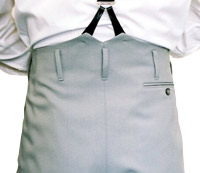
You can also go with a button fly if you want, but this is hardly necessary.
Vest/Waistcoat (optional)
Vests should have around 6 buttons (double or single breasted. Double may have 8) and extend above the gorge (neck opening) of the jacket UNLESS the jacket is double breasted, in which case the gorge should match EXACTLY to the jacket. It can have up to four pockets (5 if it has a ticket pocket) and can have besom, flaps, or welt. I recommend welt. The single breasted can have shawl or notch lapels, or no lapel. Double breasted should have shawl or peak lapels. Double breasted vests go with single breasted jackets. Single breasted vests go with both jackets. All vest should fit tightly and overlap the pants by about an inch. ALWAYS wear suspenders with a vest, no belts.
Fabric colors
For the most part, I'll leave this to your discretion, but you can't go wrong if you start with black, navy, or dark grey. Pinstripes are good for all body types, but tall men should have wider spaced stripes. Checked are good for all as well, but windowpane patterns are good for taller, thinner men. The higher the wool content, the better.
How to match Shoes to Suit
General rule, brown shoes go with white/off white, brown/tan, blue, and lighter grey suits. Black go with just about all suit colors.
That's about all for now. I'll expand again at some point for accessories, ties, and other bits and bobs. Goodnight for now.
Saturday, February 18, 2012
What a Mess
So, sorry I've been gone for a few days. Valentine's day plans and whatnot have taken up quite a bit of time. I like to do it up, as it were. Anyway, I noticed I neglected to mention one piece of evening wear in my black tie essay: The White Mess Jacket.

Now, the civilian mess jacket (it is still worn in the military) was only really "in style" for less than ten years, there aren't really any rules for it. It is most often seen with a cummerbund, but a low cut black vest is also correct. Turndown collars are the norm, but wing collars work too. I've seen them with peaked and shawl lapels (never notch) and usually self-faced (as opposed to silk/satin faced). Either plain gold or self-faced buttons are fine. It is a very natty look if you can pull it off, but there are a few caveats. First off, do not try if you are of less-than-athletic build, it won't flatter you. Second, there is the ever-present risk of looking like a waiter. But, now that you've been warned, I'll move on to how you may acquire a mess jacket of your own.
First off, custom made. Obviously terribly expensive, but will get it fitting right.
Second off, find a military one. You can find them new, but fairly expensive, or try trawling ebay to find a vintage one cheaper. However, beware as fit is everything so, if it doesn't fit right, it won't look good. If you happen to find one, get a tailor to change out the buttons if needed and remove the epaulet loops on the shoulders.
Third off (and least advised): Find a cheap ivory/off white tailcoat and have a tailor remove the tails. Beware satin faced lapels and stiff polyester material like the plague.

My own, former military mess jacket.
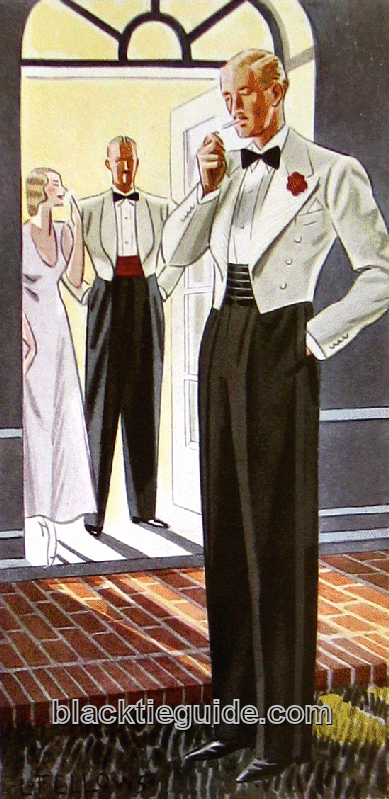
Now, the civilian mess jacket (it is still worn in the military) was only really "in style" for less than ten years, there aren't really any rules for it. It is most often seen with a cummerbund, but a low cut black vest is also correct. Turndown collars are the norm, but wing collars work too. I've seen them with peaked and shawl lapels (never notch) and usually self-faced (as opposed to silk/satin faced). Either plain gold or self-faced buttons are fine. It is a very natty look if you can pull it off, but there are a few caveats. First off, do not try if you are of less-than-athletic build, it won't flatter you. Second, there is the ever-present risk of looking like a waiter. But, now that you've been warned, I'll move on to how you may acquire a mess jacket of your own.
First off, custom made. Obviously terribly expensive, but will get it fitting right.
Second off, find a military one. You can find them new, but fairly expensive, or try trawling ebay to find a vintage one cheaper. However, beware as fit is everything so, if it doesn't fit right, it won't look good. If you happen to find one, get a tailor to change out the buttons if needed and remove the epaulet loops on the shoulders.
Third off (and least advised): Find a cheap ivory/off white tailcoat and have a tailor remove the tails. Beware satin faced lapels and stiff polyester material like the plague.

My own, former military mess jacket.
Tuesday, February 14, 2012
Two bits
So, it's late again and I can't get to sleep yet (seems I never get to sleep before 4 anymore) so I figured I'd give some more details on vintage shaving (or, at least, how I do it) for those out there who want to give it a try. Ladies, this may be helpful for you too.
First off, I'll skip straight razor technique for now because, well, I'd guess very few of you reading will be crazy enough to give it a try (or be willing to shell out the cash for a good razor, sheesh). This will have more to do with the old fashioned, double edged razors. I picked up mine (It's a vintage Gillette) at an antique shop for about $25, took it home, scrubbed it with a brillo pad (it's brass and copper so there was some oxidation), and sanitized it in alcohol. Brand new ones can be found for anywhere from $30 to $50 online. Most of them are pretty simple in design with three pieces. First, there's the rounded bit that actually makes contact with the skin. This usually has a threaded bolt in the middle.
.JPG)
Next is a flat bit with a hole in it that slides on over the bolt. The blade gets sandwiched between these two parts.
.JPG)
Last is the handle, which screws onto the bolt.
.JPG)
And, voila, a simple razor. Now, first off, since this is a mostly bare blade, it is a little easier to cut yourself and takes a BIT more time than a modern razor. For me, it takes about 5 minutes per pass (i.e. 5 min to go just with the grain, 10 if I want to go with, then against). However, it gives a much closer shave, when done right. Also, the blades are dirt cheap, unlike cartridge razors. So, now that we've figured that out, let's get started.
At this point, you need a brush and some shaving soap. The soap can be had at any pharmacy (CVS, Rite Aid, Walgreen's etc.) or even Walmart, Kmart, and Target. I'd suggest investing in a decent brush, though. I like badger hair, personally. To lather up the soap, first run warm water over the brush. The brush will soak up some water in the process. Next, make small circles over the soap with the brush, applying a little pressure. This should give you a decent lather pretty quickly. Next, apply the lather to your face in small circles. This makes the hair stand, making it easier to cut (applying normal, canned cream with your hands doesn't do this). If you want, you can precede all of this with a hot towel on your face to soften it, but it is hardly necessary.
Once you're lathered up, it's time to start shaving. what you want to do for the first few times is lay the rounded part flat on your skin, then slowly rock it until the blade touches your skin. With time, you will be able to intuitively touch the blade edge to your face without this. It will feel strange at first because the handle is at a near 90 degree angle to your face, but you will get used to it. Now, for those of you that don't know the grains of your face, here are some tips (may vary, everyone's face is different).
With the grain:
Cheeks: down and inward
Chin: down and outward
Moustache: straight down center, angled down sides
Neck: down
Against the grain is all exactly the opposite. Alternatively, there is across the grain (aka X grain), which will give a closer shave, but is much harder and will often result in lots of cuts. NEVER start with X grain or against the grain, always start with the grain. Not doing so will result in severe irritation and, often, nicks.
Now, once you've finished, splash some cold water on your face (or, submerge it in a sink full of cold water if you have the time or patience). This will close up the pores on your face, preventing infection, ingrown hairs, and razor bumps. Clean up any nicks with a styptic pen (any pharmacy will have it) and apply your aftershave of choice (I recommend Old Spice and Pinaud's Clubman for cheap, classic aftershaves that smell great).
That should just about do it, I think. Any questions, feel free to comment below. Thanks for reading.
First off, I'll skip straight razor technique for now because, well, I'd guess very few of you reading will be crazy enough to give it a try (or be willing to shell out the cash for a good razor, sheesh). This will have more to do with the old fashioned, double edged razors. I picked up mine (It's a vintage Gillette) at an antique shop for about $25, took it home, scrubbed it with a brillo pad (it's brass and copper so there was some oxidation), and sanitized it in alcohol. Brand new ones can be found for anywhere from $30 to $50 online. Most of them are pretty simple in design with three pieces. First, there's the rounded bit that actually makes contact with the skin. This usually has a threaded bolt in the middle.
.JPG)
Next is a flat bit with a hole in it that slides on over the bolt. The blade gets sandwiched between these two parts.
.JPG)
Last is the handle, which screws onto the bolt.
.JPG)
And, voila, a simple razor. Now, first off, since this is a mostly bare blade, it is a little easier to cut yourself and takes a BIT more time than a modern razor. For me, it takes about 5 minutes per pass (i.e. 5 min to go just with the grain, 10 if I want to go with, then against). However, it gives a much closer shave, when done right. Also, the blades are dirt cheap, unlike cartridge razors. So, now that we've figured that out, let's get started.
At this point, you need a brush and some shaving soap. The soap can be had at any pharmacy (CVS, Rite Aid, Walgreen's etc.) or even Walmart, Kmart, and Target. I'd suggest investing in a decent brush, though. I like badger hair, personally. To lather up the soap, first run warm water over the brush. The brush will soak up some water in the process. Next, make small circles over the soap with the brush, applying a little pressure. This should give you a decent lather pretty quickly. Next, apply the lather to your face in small circles. This makes the hair stand, making it easier to cut (applying normal, canned cream with your hands doesn't do this). If you want, you can precede all of this with a hot towel on your face to soften it, but it is hardly necessary.
Once you're lathered up, it's time to start shaving. what you want to do for the first few times is lay the rounded part flat on your skin, then slowly rock it until the blade touches your skin. With time, you will be able to intuitively touch the blade edge to your face without this. It will feel strange at first because the handle is at a near 90 degree angle to your face, but you will get used to it. Now, for those of you that don't know the grains of your face, here are some tips (may vary, everyone's face is different).
With the grain:
Cheeks: down and inward
Chin: down and outward
Moustache: straight down center, angled down sides
Neck: down
Against the grain is all exactly the opposite. Alternatively, there is across the grain (aka X grain), which will give a closer shave, but is much harder and will often result in lots of cuts. NEVER start with X grain or against the grain, always start with the grain. Not doing so will result in severe irritation and, often, nicks.
Now, once you've finished, splash some cold water on your face (or, submerge it in a sink full of cold water if you have the time or patience). This will close up the pores on your face, preventing infection, ingrown hairs, and razor bumps. Clean up any nicks with a styptic pen (any pharmacy will have it) and apply your aftershave of choice (I recommend Old Spice and Pinaud's Clubman for cheap, classic aftershaves that smell great).
That should just about do it, I think. Any questions, feel free to comment below. Thanks for reading.
Monday, February 13, 2012
I'm putting on my top hat...
So, this little essay will probably be fairly lost on most people because, well, no one wears white tie and tails anymore. But I figured I'd write it anyway because it's 1 AM and I'm bored. White tie and tails (aka White tie or Full Dress) is the closest thing to a civilian uniform there is, which turns most people off to it. However, there is plenty of variety to be had when wearing white tie as well (provided you do it right). But, doing it differently can get pretty expensive too. Either way, I'll show you some of the does and do-nots of tails.
The Tailcoat
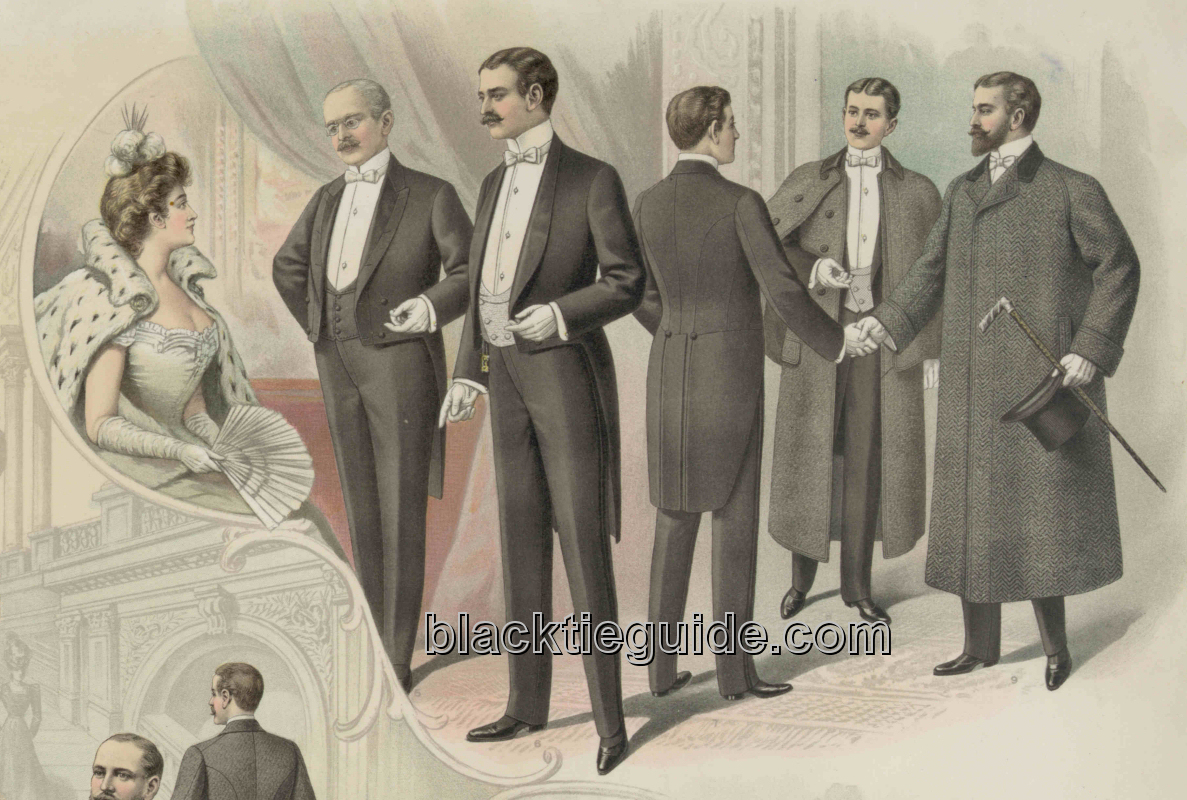
The tailcoat should have the appearance of being double breasted, but should not be able to close. You'll see some tailcoats out there with one button that closes in the center; this is for waitstaff or fancy dress only. Do not wear this to a white tie function. Also, it should be black or midnight blue ONLY (sound familiar) and the pants should match. Also, matching cloth covered buttons are a must. There are two types of lapels appropriate for the formal tailcoat. Some sartorialists will be confused here; most would say that only peaked lapels belong on the tailcoat, and I think they're MOSTLY right. However, the other option I would endorse (albeit, with caution) is the M or Claw-hammer Lapel.

Of course, this will require a custom tail-suit (as will most variation on the coat itself). Another variation is lapel facings. Of course, black grosgrain silk is the norm, and is quite dashing, but a self-trimmed lapel is equally so.

Note both men's coats are self trimmed (be sure to avoid the velvet collar and purple waistcoat of Mr. Downey, though.)
Last, but not least, is the general cut of the coat. Most are used to the average, formal tailcoat as being uniform across the board. Not true. For instance, most tailcoats are cut with a slanted front hem (to follow the lines of the vest).

However, a straight hem is equally acceptable and looks great if worn with a straight hemmed waistcoat (as well as with the standard, pointed type.

This also opens a door to the button placement. Most tailcoats have a keystone button placement, where they slant up, toward the shoulders, but a straight hem allows a shorter lapel and a straight button configuration.

(This also shows a rare lapel style; a shawl lapel over the peaked lapel. Not my style, but definitely interesting.)
The Waistcoat/Vest
Let me say this immediately. With white tie, you MUST wear a vest. No cummerbund or anything else. Furthermore, it should be some shade of white/off white. SOME say that since a black waistcoat was fine in the Victorian age, it's fine now. They may be right but, to me, it doesn't look half as good as white. But, that's my opinion, so take it with a grain of salt. However, the vest is where you can take the most liberty for expression. The rules to the vest are:
A. It must be white/off white/cream
B. It must be low-cut (three buttons, four if double-breasted) and have lapels
C. It must not extend below the front of the tailcoat.
Otherwise, all is fair game. The most common is the white, backless, pique waistcoat.

While this is certainly fine, and very handsome, there is so much more that can be done. For instance, a straight hemmed, shawl lapel waistcoat

Or the double breasted waistcoat (straight or pointed hem)

And, of course, off-white/cream brocade vests as seen on the above picture of Jude Law and Robert Downey Jr. Also, a watch chain will not go amiss.
The Shirt
You have a few alternatives here, really. First off, the shirt should have a detachable collar, barrel cuffs for cufflinks, and a stif front. It must be white. The front can be either a "boiled front" or pique front. If you really push it, you MAY get away with a well starched, thinly pleated front. The front should have holes for studs (mother of pearl or plain white). As for collars, you have three available. The wing collar

The rounded wing.

Or the tall stand/imperial collar

Of course, the shirt should be laundered and starched to perfection.
The Pants/Trousers
Relatively identical to tuxedo pants. High rise, color to match the coat, silk stripe down the leg, no cuffs. Wear with suspenders. Plain front is better, pleats are fine.
Tie
White, pique, self-tie bow tie. If your vest is brocade, you can probably get away with a matching tie.
Shoes
Patent leather opera pumps or highly polished Chelsea boots. Some may argue the Chelsea boots, but I like them personally.
Hats
Highly polished top hat or silk collapsible top hat.
So, on the off chance you happen to get to wear white tie and tails, now you know how, or at least have an inkling of it. Goodnight all, I have some homework to catch up with.
.JPG)
The Tailcoat
The tailcoat should have the appearance of being double breasted, but should not be able to close. You'll see some tailcoats out there with one button that closes in the center; this is for waitstaff or fancy dress only. Do not wear this to a white tie function. Also, it should be black or midnight blue ONLY (sound familiar) and the pants should match. Also, matching cloth covered buttons are a must. There are two types of lapels appropriate for the formal tailcoat. Some sartorialists will be confused here; most would say that only peaked lapels belong on the tailcoat, and I think they're MOSTLY right. However, the other option I would endorse (albeit, with caution) is the M or Claw-hammer Lapel.

Of course, this will require a custom tail-suit (as will most variation on the coat itself). Another variation is lapel facings. Of course, black grosgrain silk is the norm, and is quite dashing, but a self-trimmed lapel is equally so.

Note both men's coats are self trimmed (be sure to avoid the velvet collar and purple waistcoat of Mr. Downey, though.)
Last, but not least, is the general cut of the coat. Most are used to the average, formal tailcoat as being uniform across the board. Not true. For instance, most tailcoats are cut with a slanted front hem (to follow the lines of the vest).

However, a straight hem is equally acceptable and looks great if worn with a straight hemmed waistcoat (as well as with the standard, pointed type.

This also opens a door to the button placement. Most tailcoats have a keystone button placement, where they slant up, toward the shoulders, but a straight hem allows a shorter lapel and a straight button configuration.

(This also shows a rare lapel style; a shawl lapel over the peaked lapel. Not my style, but definitely interesting.)
The Waistcoat/Vest
Let me say this immediately. With white tie, you MUST wear a vest. No cummerbund or anything else. Furthermore, it should be some shade of white/off white. SOME say that since a black waistcoat was fine in the Victorian age, it's fine now. They may be right but, to me, it doesn't look half as good as white. But, that's my opinion, so take it with a grain of salt. However, the vest is where you can take the most liberty for expression. The rules to the vest are:
A. It must be white/off white/cream
B. It must be low-cut (three buttons, four if double-breasted) and have lapels
C. It must not extend below the front of the tailcoat.
Otherwise, all is fair game. The most common is the white, backless, pique waistcoat.
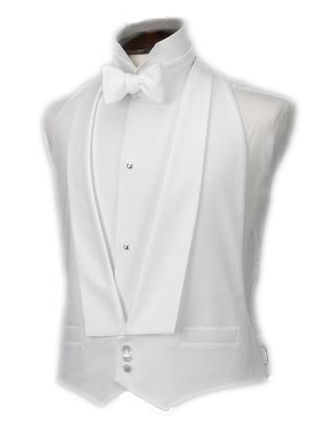
While this is certainly fine, and very handsome, there is so much more that can be done. For instance, a straight hemmed, shawl lapel waistcoat
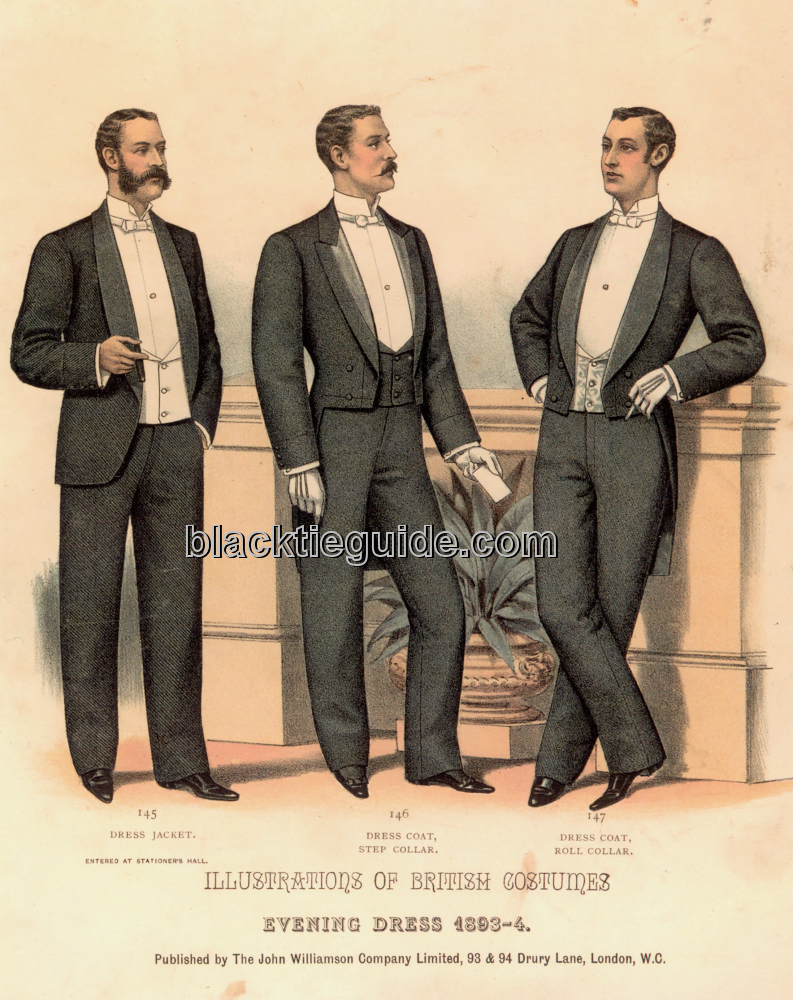
Or the double breasted waistcoat (straight or pointed hem)
And, of course, off-white/cream brocade vests as seen on the above picture of Jude Law and Robert Downey Jr. Also, a watch chain will not go amiss.
The Shirt
You have a few alternatives here, really. First off, the shirt should have a detachable collar, barrel cuffs for cufflinks, and a stif front. It must be white. The front can be either a "boiled front" or pique front. If you really push it, you MAY get away with a well starched, thinly pleated front. The front should have holes for studs (mother of pearl or plain white). As for collars, you have three available. The wing collar

The rounded wing.

Or the tall stand/imperial collar

Of course, the shirt should be laundered and starched to perfection.
The Pants/Trousers
Relatively identical to tuxedo pants. High rise, color to match the coat, silk stripe down the leg, no cuffs. Wear with suspenders. Plain front is better, pleats are fine.
Tie
White, pique, self-tie bow tie. If your vest is brocade, you can probably get away with a matching tie.
Shoes
Patent leather opera pumps or highly polished Chelsea boots. Some may argue the Chelsea boots, but I like them personally.
Hats
Highly polished top hat or silk collapsible top hat.


So, on the off chance you happen to get to wear white tie and tails, now you know how, or at least have an inkling of it. Goodnight all, I have some homework to catch up with.
.JPG)
Sunday, February 12, 2012
The Orbit Lounge
The Orbit Room in Chicago is a retro/rockabilly themed bar in the Avondale neighborhood. It's definitely got a cool 50s feel to it but without overdoing it. Thankfully, it stays away from the stereotypes prevalent in most 1950s themed establishments and keeps to a darker, moodier atmosphere. Unfortunately, I couldn't get any decent photos due to the low lighting, but some photos can be seen on their website. It was dead when we got there, around 6, but started picking up around 7. The waitress/bartender was nice and the food was decent, if a tad pricey for bar fare. Overall, pretty decent place if you're in the neighborhood, but not someplace I'd go out of my way to see again. In other news, I'll be seeing more rockabilly venues in the near future, so keep an eye out. Also, gave my buddy Colin a pompadour to fit in.


.JPG)
.JPG)


Oh, and my own pomp
.JPG)
.JPG)
Overall, fun night. And on that note, goodnight all. See ya tomorrow.
Subscribe to:
Posts (Atom)